InsightsThought leadership · July 2026
The Provenance Ladder: AI content compliance becomes production infrastructure
From 2 August 2026, the EU AI Act requires machine-readable marking of synthetic content. Our four-rung framework for building provenance into the production pipeline, and for choosing the rung your brand actually needs.
9 min read
Executive summary
The EU AI Act’s Article 50 transparency obligations take effect on 2 August 2026. From that date, synthetic content reaching EU audiences must carry machine-readable markings, with penalties up to €15 million or 3% of global turnover. The obligation follows the content, not the company: an APAC brand whose AI-generated campaign assets surface in European feeds is in scope regardless of where it is headquartered.
Most organisations are treating this as a legal memo. It is a production-architecture problem. Disclosure that must be machine-readable, per asset, at the volumes AI production now runs (across our production operation, 360–400 assets per employee per month) cannot be handled by a labelling step bolted onto the end of a workflow. It must be generated by the pipeline itself.
Key findings
- Article 50 applies from 2 August 2026. Systems already on the market have until 2 December 2026 to meet the machine-readable marking requirement, but newly deployed systems must comply immediately (European Commission, AI Omnibus provisional agreement, May 2026).
- The market is converging on a technical answer: the C2PA content-credentials ecosystem passed 6,000 members in January 2026, and OpenAI and Google announced a dual-layer provenance model (C2PA metadata plus SynthID watermarking) on 19 May 2026.
- The commercial case has arrived ahead of the legal one: IAB research shows the gap between how positively executives believe consumers view AI ads and how consumers actually view them has widened to 37 percentage points.
- Provenance maturity separates into four distinct rungs (Disclosed, Marked, Traced, Audit-Grade), and most brands producing AI content today sit below the rung that regulation requires from 2 August.
- The top rung is not a universal target. For most brands, matching the rung to production volume and legal exposure matters more than climbing. Full lineage infrastructure has real costs, and below certain volumes a disciplined manual register is a defensible position.
The shift: why now
Three timelines converged in the six weeks before this report.
The regulatory timeline. Article 50 of the EU AI Act applies from 2 August 2026. It requires providers of generative AI systems to embed machine-readable marks in synthetic output, and deployers to disclose deepfakes and AI-generated text on matters of public interest. The European Commission’s Code of Practice on Transparency of AI-Generated Content reached its final drafting stage in June 2026. The AI Omnibus agreement of May 2026 grants systems already on the market a transitional window to 2 December 2026 for machine-readable marking, but for anything placed on the market after 2 August the obligation is immediate. Non-compliance carries fines up to €15 million or 3% of total global annual turnover, whichever is higher.
The industry timeline. The IAB released the industry’s first AI Transparency and Disclosure Framework on 15 January 2026, establishing a risk-based standard for when AI use in advertising requires consumer-facing labels. Synthetic humans, digital twins and generated voices sit squarely in scope. Meanwhile the C2PA content-credentials standard moved from consortium project to default plumbing: over 6,000 members and affiliates as of January 2026, TikTok labelling over 1.3 billion videos with provenance data, and the OpenAI–Google dual-layer announcement of 19 May 2026 aligning the two largest model providers on a common approach.
The trust timeline. IAB research finds 82% of advertising executives believe younger consumers feel positively about AI-generated ads; only 45% actually do. That perception gap has widened from 32 to 37 points since 2024 (IAB / Sonata Insights, 2026). The consumer backlash that trade press has labelled the “AI slop” problem is, underneath the sentiment, a provenance problem: audiences cannot distinguish considered AI-assisted craft from automated volume, so they discount all of it.
The convergence matters because each timeline demands the same asset: a verifiable record of how each piece of content was made. Regulation demands it in machine-readable form. Industry frameworks demand it at the point of disclosure decision. Consumer trust rewards brands that can prove, not merely claim, how their content is produced.
The framework: the Provenance Ladder
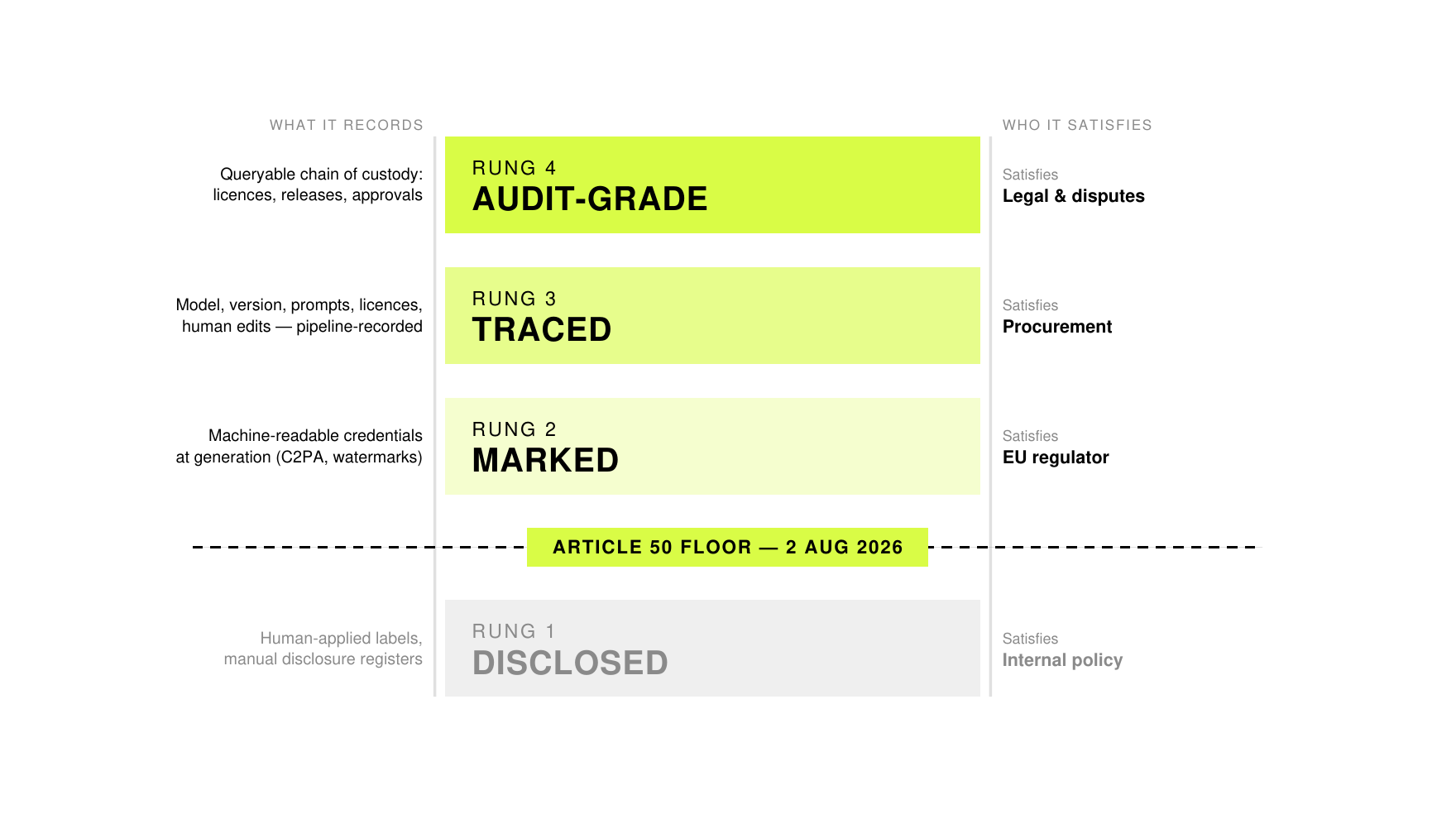
Provenance capability is not binary. In our production work we observe four distinct rungs, each with different tooling, cost and defensibility.
Rung 1: Disclosed. Human-applied labels: “Created with AI” captions, manual disclosure registers, platform checkboxes. This is where most brands sit. It satisfies internal policy but fails Article 50’s machine-readable requirement, and it collapses at volume. Manual labelling of thousands of monthly assets is where compliance goes to die.
Rung 2: Marked. Machine-readable marking embedded at generation: C2PA content credentials, SynthID-class watermarks, IPTC metadata. This is the Article 50 floor. It is increasingly free, as major model providers now embed credentials by default, but it only records that content is synthetic, not how it came to be.
Rung 3: Traced. Pipeline-level lineage: which model and version generated the asset, from which prompts and reference inputs, under which licence terms, with which human edits. Tracing requires production infrastructure. The record must be created as a by-product of making the asset, not reconstructed afterwards. This is the rung that answers procurement’s questions, not just the regulator’s.
Rung 4: Audit-Grade. Full chain of custody, queryable on demand: every asset’s lineage linked to model licences, talent and likeness releases, and brand-approval checkpoints, retained and retrievable for the life of the asset. This is what legal teams will ask for the first time a campaign is challenged, and what indemnification discussions will increasingly assume.
Regulation sets the floor at Rung 2, but commercial pressure (procurement questionnaires, indemnity negotiations, platform policies) is already pricing in Rungs 3 and 4. Climbing one rung reactively each time you are asked is far more expensive than building the recording infrastructure once.
The limits of the ladder
Rung 4 is not a universal target, and treating it as one is over-engineering. A brand producing a few dozen AI-assisted assets a month can defend a disciplined Rung 1 register plus the Rung 2 credentials major model providers now embed by default; the cost of full lineage infrastructure would exceed the risk it retires.
Climbing has real costs that advocates of provenance tooling, ourselves included, tend to understate. Recording infrastructure constrains tool choice, adds workflow rigidity, and slows adoption of new models, because every new tool must be plumbed into the record before it can be used in production. The right question is not “how high can we climb” but “which rung do our volume, EU exposure and contract book actually require”. For many brands the honest answer this year is Rung 2.
Evidence in practice
| Figure | What it means |
|---|---|
| 360–400 | assets per employee per month: the operating volume of AI-native production, at which manual disclosure systematically fails (UNCANNY production operation) |
| €15M / 3% | of global turnover, whichever is higher: the maximum penalty for Article 50 non-compliance (EU AI Act) |
| 15.3% | of marketing budgets now go to AI initiatives, yet only 30% of CMOs report mature AI readiness (Gartner CMO Spend Survey, May 2026) |
Scale is what breaks manual approaches. Across our production operation, output runs at 360–400 assets per employee per month. At that volume, any disclosure step that depends on a human remembering to apply a label fails not occasionally but systematically. The only provenance that survives scale is provenance generated by the pipeline itself.
This is why tracing has to be architected into the pipeline rather than bolted on afterwards: the asset must carry its generation record (model, version, inputs, edit history) from the moment it exists. Built that way, the marginal cost of Rung 3 provenance approaches zero, because the record is a by-product of production rather than a separate task. The cost of retrofitting it across a year of published assets is somewhere between painful and impossible. This holds whoever builds the pipeline: an in-house content team, an agency or a platform vendor.
Where the record lives also determines its durability. Provenance captured at pipeline level, above any individual model or tool, survives model changes, because it records which model produced what under which terms. Provenance inherited from a single model vendor’s native tooling is only as durable, and as portable, as that vendor’s roadmap. Neither approach is free: pipeline-level recording is infrastructure someone must build and maintain, which is precisely why it belongs in the budget conversation now rather than after an audit.
Market context reinforces the urgency. CMOs now allocate 15.3% of marketing budgets to AI initiatives, yet only 30% report mature AI readiness. Provenance is a large part of that unreadiness: budget has flowed to generation capability, not to the record-keeping that makes generated content defensible.
Implications for leaders
- Locate yourself on the Ladder this month. Sample 20 recent AI-touched assets and ask: could we produce a machine-readable generation record for each within 24 hours? If not, you are at Rung 1, below the Article 50 floor.
- Ask for records, not policies. Whoever produces your AI content (an in-house team, an agency or a platform) should be able to show the lineage record for a delivered asset, not a policy PDF. A team that cannot produce one is carrying a compliance gap, and it becomes yours at publication.
- Budget for the rung you need, and no higher. At genuine AI volumes, a manual disclosure process is a permanent tax that still fails audits, and pipeline-embedded recording is the cheaper path. At modest volumes, it is not: a disciplined register and default model-provider credentials may be the rational stopping point.
- Treat the trust gap as the commercial case. The 37-point executive–consumer perception gap means disclosure done well is differentiation, not confession. Brands that can prove craft will be able to say so credibly; brands that cannot will be lumped in with the slop.
- Route legal interpretation to counsel. Whether specific assets constitute “deepfakes” under Article 50, and how the December transitional window applies to your systems, are questions for qualified counsel. The operational readiness described here is necessary either way.
Where this goes next
Over the next 12–24 months, expect provenance to move from compliance topic to commercial default. The December 2026 expiry of the transitional marking window removes the last grace period for existing systems. Platform enforcement will likely outpace regulators: TikTok’s 1.3 billion labelled videos suggest platforms will simply require credentials at upload. Procurement templates will begin specifying rungs, whether or not they use that language; expect “provide asset-level generation records” to appear in RFPs the way data-processing agreements did after GDPR. And indemnification, the quietest and highest-stakes corner of AI production contracts, will increasingly hinge on whether a supplier can evidence its chain of custody. The brands that built recording infrastructure early will find these conversations short. Everyone else will find them expensive.
Methodology and sources
Operating benchmarks (360–400 assets per employee per month) are UNCANNY-proprietary figures from our own production operation. Regulatory facts are drawn from the EU AI Act text and European Commission materials on Article 50 and the Code of Practice on Transparency of AI-Generated Content (artificialintelligenceact.eu; digital-strategy.ec.europa.eu); transitional-window details reflect the May 2026 AI Omnibus provisional agreement as reported by Covington (globalpolicywatch.com) and others. Industry data: IAB AI Transparency and Disclosure Framework and associated research with Sonata Insights (iab.com, January 2026); C2PA membership and TikTok labelling figures via the Content Authenticity Initiative and C2PA ecosystem reporting (contentauthenticity.org, January 2026); OpenAI–Google dual-layer provenance announcement of 19 May 2026; Gartner 2026 CMO Spend Survey (gartner.com, 11 May 2026).
Nothing in this report is legal advice; obligations under the EU AI Act should be assessed with qualified counsel.